
Leslie Wexner made his fortune selling underwear. Something most of Central Ohio weirdly took pride in, but now it is unraveling, and it was the Free Press’s Bob Fitrakis who was first to question how an underwear salesman could become one of the world’s richest men.
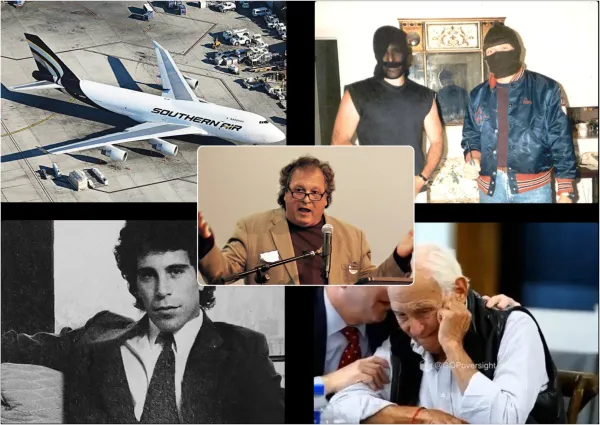
Wexner and Epstein’s connection to “Spook Air” – a CIA-linked airline that had run cocaine from South America – may have played a pivotal role helping this dangerous duo acquire their billions. Put mildly, it may not have been just underwear this airline was flying in and out of Columbus.
What Fitrakis uncovered years ago was how Wexner, with Epstein playing a pivotal role, convinced a questionable airline – Southern Air Transport – to relocate from Miami to Columbus in 1995. Specifically, to Rickenbacker International Airport, south of town. The airport has become one of the planet’s largest trade hubs and was once home to a squadron of the Tuskegee Airmen.
The planes of Southern Air Transport or “SAT” had been repurposed by Wexner and Epstein to deliver sweatshop manufactured clothing, twice weekly from Hong Kong, China, and sold at Victoria’s Secret, Abercrombie & Fitch stores and his other clothing outlets.
Once lauded as a coup for Central Ohio, landing SAT’s business at Rickenbacker eventually turned into a nightmare, as the enterprise became mired in massive debt and was closed under a cloud of suspicion about its true activities. Just how and why one of the world’s most notorious airlines ended up in Columbus was a story the local mainstream media refused to cover.
Through a Freedom of Information Act request, Fitrakis obtained a massive number of documents from the Rickenbacker Port Authority and additional records from the Ohio Department of Development showing how Franklin County Commissioners and the Ohio GOP Governor Voinovich administration offered hard-to-refuse incentives to get SAT’s business, despite the airline’s shady history.
“We are proud of Rickenbacker’s growth and believe the addition of Southern Air Transport would represent a significant step forward,” said Franklin County Commissioner Arlene Shoemaker in 1995. Millions in taxpayer funded incentives were given to make the necessary infrastructure improvements at Rickenbacker, while Franklin County granted a 100-percent abatement for 15 years on property improvements.
Apparently, both local and state officials were unaware of or ignored SAT’s covert past. The CIA owned the airline from 1960 to 1973, and at one point was the CIA’s largest “proprietary”– a private business owned by the CIA – with estimated assets of more than $50 million and more than 8,000 employees worldwide.
“This will help Columbus tremendously in becoming a world-class inland port,” said Gov. Voinovich, a Republican, at the time to the Columbus Dispatch.
Was the governor of Ohio in the dark that SAT still had secret ties to the CIA? Knowing Voinovich’s history, he probably was aware – as was Epstein and Wexner. Ten years prior to coming to Columbus an SAT plane was shot down over Nicaragua in 1986, giving the world a rare window into U.S. government covert activity.
There was one survivor, Eugene Hasenfus, and his story pulled a string that eventually unraveled the scandal known as Iran-Contra. The CIA was shipping weapons to Iran, using Israel as a middleman, and deploying the profits to arm the CIA-backed Contras against of Nicaragua against the leftist political party in power at the time the Sandinistas.
And during the three years in Columbus, the airline was dogged by rumors it had been – and still was – involved in drug smuggling. Indeed, in 1996, customs agents discovered cocaine hidden aboard an SAT plane, as reported by the Mobile Register (Alabama). SAT’s public information officer told the newspaper the plane was delivering “fresh flowers” from Colombia.
According to Fitrakis, investigators in both the Franklin County Sheriff’s Office and Ohio’s Office of Inspector General were looking into SAT amid ongoing public scrutiny of the Iran-Contra affair – and both offices identified Epstein as the major influence in bringing SAT to Columbus. From the state and county investigation, Fitrakis learned of Wexner and Epstein’s connection to the unsolved mob-style murder of the Limited’s attorney and with Walsh trucking, also linked to organized crime.
In 1986, SAT secretly shipped 90 tons of TOW missiles to Iran as part of the Reagan administration’s secret arms-for-hostages exchange. Proceeds from the sale of the missiles – some $16 million – were diverted to the Contra resupply effort in Central America.
The flight logs of the downed SAT C-123 linked it to a history of involvement with the CIA, cocaine and the Medellin drug cartel in Colombia. The logs documented several SAT flights to Barranquilla, Colombia, during October 1985, the same time Wanda Palacios, a Miami FBI informant, told the FBI that the airline was running drugs.
This same airplane was flown by infamous Louisiana drug dealer Barry Seal during a joint CIA-DEA sting operation in 1984 against the Sandinistas. Seal acquired the plane through a complicated airline swap with the Medellin cartel, according to declassified government documents, and the plane was fitted with hidden cameras by the CIA at Rickenbacker Air Force Base – and this was before the airline relocated to Columbus. Seal reportedly flew weapons for the Contras and returned to the US with cocaine. He was murdered in New Orleans in 1986 by Colombian hitmen.
In August 1987, the New York Times reported Palacios informed Congressional investigators that “she witnessed drugs being exchanged for guns intended for the Contras.” Palacios identified SAT planes involved in the gun and drug running in two separate incidents in 1983 and 1985. Initially SAT denied any connection to the CIA and dismissed accusations of drug running as absurd.
Although SAT issued an internal memo denying any post-Iran-Contra connections to the CIA, during the Gulf War in 1990-91, SAT played a key role in logistic support for the U.S. military. And in September 1990, the Air Force awarded SAT a $54 million contract for “air transport services.” Early 1996 opened for SAT with the same story line when it garnered a 90-day contract to transport construction supplies, equipment and civilian personnel from Zagreb, Croatia, to Tuzla, Bosnia, one of the world’s military hot spots.
One journalist in particular tried to expose the running of weapons across the world, with some paid for with illicit drugs such as cocaine, and shipped back to the US to air hubs such as Rickenbacker. Gary Webb wrote about this in the San Jose Mercury News’ 1996 “Dark Alliance” series concerning crack cocaine, the CIA, and the Nicaraguan Contra army. Webb (allegedly) committed suicide in 2004.
Fitrakis found that SAT’s past was even darker. The original CIA owned gun-and drug-running airline, the notorious Air America, morphed into Southern Air Transport. During the Vietnam War, Air America ran opium and heroin out of Laos to military bases in Southeast Asia. By the end of the Vietnam War an estimated 13 percent of U.S. soldiers were addicted to drugs.
In December of 1996, the Dispatch reported that SAT was “delinquent in paying a $277,000 personal property tax bill.” The following year, SAT issued layoff notices to 100 of its 750 employees. More layoffs followed, and SAT, which had promised 300 new jobs within three years – and had already taken at least $3.5 million in state money – admitted that it hadn’t begun work on the maintenance facility project it had promised.
In 1998, SAT informed Ohio’s Department of Development that “Southern Air’s project will not proceed as planned at Rickenbacker due to severe financial difficulty.” Robert Dahl, a consultant, summed up SAT’s financial woes at the time by pointing out “there are fewer belligerent circumstances in the world today than there were during the Cold War.” Apparently Spook Air needed the Soviets and the Red Menace to survive.
The Dispatch managed to put a positive spin on the death of Spook Air: “But there were plenty of good times for Southern Air. Its Hercules fleet became the pack mules of the skies, transporting odd-size cargo, including Keiko, the whale, and taking part in humanitarian airlifts to Bosnia and Somalia.” Like local officials, the Dispatch ignored the mounting evidence of SAT’s ties to cocaine smuggling.
On October 1, 1998, the CIA Inspector General issued his report outlining allegations of Southern Air Transport’s involvement in drug-running. That same day, Spook Air filed for bankruptcy in Columbus.
Portions of this article are from Fitrakis' article Spook Air.